

Recommended




Spain and Morocco agreed this Thursday to strengthen coordination and efforts to address the migration crisis affecting Ceuta, and committed to reviewing and implementing measures for the delivery, as soon as possible, of all people who entered that Spanish North African city irregularly.
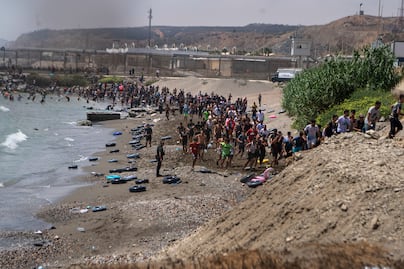
The Spanish Interior Ministry highlighted in a statement the "exemplary collaboration" between Spain and Morocco in all areas, including migration, amid a crisis caused by the entry into Ceuta of between 1,500 and 2,000 migrants who swam from Morocco, according to local authority data.
The Interior Ministry denounced that human trafficking networks are "instrumentalizing" a court ruling to encourage the flow of undocumented migrants toward Spain, mostly young people.
The Spanish Supreme Court confirmed at the beginning of July that the immigration law does not allow for 'border rejections,' also known as 'hot returns' (immediate expulsion), of migrants intercepted on the high seas.
Thousands of young Moroccans arrived today at the border between Castillejos (Morocco) and Ceuta to try to cross the fence separating the two cities, as EFE was able to verify.
Hundreds of them jumped over the protective fences, which were not guarded by police at that moment, and entered Ceuta, while Moroccan auxiliary force agents who handle security on the ground withdrew as the young people passed by.
Spanish Interior Minister Fernando Grande-Marlaska will travel this Friday to Ceuta due to the migration crisis, a city that asked the Spanish government to close the border with Morocco in an "urgent and non-deferrable" manner.
In a statement, the minister thanks the Moroccan authorities for the efforts of the last few days, which prevented thousands of irregular entry attempts.
Grande-Marlaska has remained in constant communication with his Moroccan colleague, Abdelouafi Laftit, according to the Ministry. EFE

[Publicidad]