

Recommended



The interview for the B1/B2 tourist visa usually lasts only a few minutes, but that brief encounter defines the outcome of the entire process.
Although there is no list of magic answers that guarantee approval, U.S. authorities point out that consular officers seek to verify three fundamental aspects: that the trip is temporary, that the applicant has legitimate motives for visiting the country, and that they have sufficient reasons to return to their place of residence.
According to the Department of State, the visitor visa is intended for people who wish to travel temporarily to the United States for tourism, family visits, shopping, or activities permitted under the B1/B2 category.
What are consular officers really looking for?
During the interview, the officer reviews the information previously provided in the DS-160 form and asks questions to confirm that the reason for the trip is legitimate and that the answers match the declared data. Consistency, honesty, and clarity are key factors during the evaluation.
Questions usually focus on:
- Motivo del viaje.
- Destinos que visitará.
- Duración de la estancia.
- Situación laboral.
- Ingresos y solvencia económica.
- Historial de viajes.
- Familiares que viven en Estados Unidos.
The answers that tend to generate the most confidence
1. When they ask: What is the purpose of your trip?
A solid answer is usually specific and direct.
Convincing answer: "I am going on vacation to Orlando for 10 days with my family. We plan to visit the theme parks and return to Mexico at the end of the trip."
This type of answer helps because it clearly explains the purpose of the visit and shows that a defined plan exists.
2. How long do you plan to stay?
Officers seek to confirm that it is a temporary stay.
Convincing answer: "I will be there for two weeks. I have that vacation period approved at my job and will return to resume my activities."
The specific duration and the existence of work commitments usually reinforce the credibility of the application.

3. Where do you work?
Stable employment can serve as evidence of ties to your home country.
Convincing answer: "I have worked as an accountant at a manufacturing company for seven years and currently supervise the finance department."
Detailed and consistent answers with the DS-160 allow the officer to better understand the applicant's professional situation.
4. Who will pay for the trip?
Financial capacity is one of the aspects usually reviewed during the interview.
Convincing answer: "I will cover all expenses with my savings and my work income."
If another person will cover the expenses, it is important to explain it clearly and truthfully.
5. Do you have family in the United States?
The recommendation is to always answer honestly.
Convincing answer: "Yes, I have a sister who lives in Texas. I will visit her for a few days and then continue with my tourist trip."
Hiding relatives or providing incorrect information can cause inconsistencies with the records reviewed by the officer.
6. Have you traveled abroad before?
Travel history helps officers understand the applicant's immigration background.
Convincing answer: "Yes, I have traveled to Canada and Spain for tourism and I returned within the authorized periods."
Responding with precise information helps to strengthen credibility during the interview.
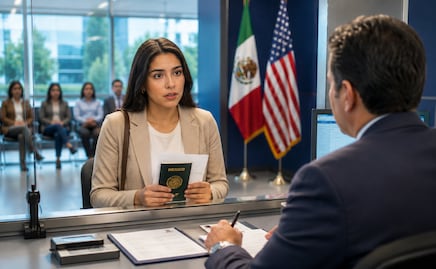
The element that most convinces the officer: coherence
Beyond elaborate answers, the factor that usually carries the most weight is the consistency between what appears in the DS-160 form and what is said during the interview. Consular officers have access to the information provided previously and verify that there are no contradictions.
For this reason, the answers that tend to generate the most confidence are those that:
- Son breves y claras.
- Coinciden con el DS-160.
- Explican un motivo legítimo de viaje.
- Muestran capacidad económica acorde al viaje.
- Reflejan vínculos sólidos con el país de residencia.
What answers can generate doubts?
Experts often warn that vague or inconsistent answers can lead to additional questions. For example:
"I don't know how long I will stay."
"I haven't decided yet what I will do in the United States."
"I don't remember what I put on my application."
"A friend will pay for everything," without being able to explain who they are or what the relationship is.
This type of answer can make it difficult for the officer to determine that the trip will be temporary and that the information presented is reliable.
Providing false or contradictory information can lead to an immediate denial and even more serious immigration consequences. Officers review the DS-160 form, immigration history, and other available records to verify the veracity of the information.
Join our WhatsApp channel. VIVE USA is now available! Stay informed from your mobile device about the most relevant news regarding travel, work, life in the United States and Canada, celebrities, trends, and much more.

[Publicidad]