

Recommended



Tracking the phones of the Ayotzinapa students who have been missing since 2014 has led Mexican authorities to two new paths: a possible network linked to funeral homes and the Forensic Medical Service (Semefo) of Iguala (Guerrero, south) and the hypothesis that about 17 students passed through the municipal police station before their disappearance.
The phone tracking was possible because criminals and officials illegally used the missing persons' phones.
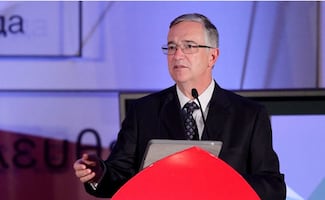
In a press conference to present progress in the investigation, 12 years after the disappearance, the case prosecutor, Mauricio Pazarán, explained this Monday that the re-analysis of phone records from 2014 and 2015 made it possible to identify 17 new people who had not been investigated.
He also indicated that it was possible to reconstruct communications between members of the criminal organization Guerreros Unidos, police officers, public servants, and private individuals during the night of September 26 and the early hours of September 27, 2014.
"Today we know who communicated with whom, how many times, at what moment," affirmed Pazarán, who detailed that one of those crossovers led to Rodolfo, a funeral home businessman whose family also operated the Semefo and had a stake in the municipal cemetery.
The Mexican Prosecutor's Office also established that Rodolfo used the phone of student Julio César Mondragón Fuentes on October 4, 2014, a detail that reinforced the investigation into funeral homes and led to search warrants.
At the El Ángel Funeral Home, authorities reported finding a bone remain stored in a drawer, a firearm, documentation, an unregistered crematorium, death certificates, transfer documents, and burial authorizations signed and stamped in blank.
Subsequent searches at the funeral home and the Semefo led to the location of 23 pieces of evidence, including hundreds of bone fragments, dental prostheses, and biological remains.
Part of the material remains under analysis with the participation of the Argentine Forensic Anthropology Team, which is also working on the case.
The Prosecutor's Office links this evidence to testimonies suggesting that some young people may have been taken to funeral homes, so it is investigating as a hypothesis a network used by Guerreros Unidos to make evidence disappear.
Seven people related to this line of investigation are linked to the process, according to the authorities.
Students' phones and the police station
Another priority line of investigation seeks to clarify if about 17 students passed through the Iguala Barandilla police station.
The Prosecutor's Office is gathering seven statements—four from municipal police officers, two from members of Guerreros Unidos, and one from a survivor—and the trail of the phone of Israel Caballero Sánchez, used after the disappearance by the wife of a former public servant, as its main leads.
These elements contradict, according to the Government, the version of José Ulises Bernabé, whose extradition has been requested from the United States and who stated that only six detainees who were not students entered that night.
"For the Government of Mexico, clarifying what happened at the Barandilla station is a priority line of investigation," said the Undersecretary of the Interior, Arturo Medina.
The investigations tracked the phones of Jorge Antonio Tizapa and Jorge Aníbal Cruz, made progress on the alleged concealment of video recordings from the Palace of Justice, and extradition processes from the United States and Israel are ongoing.
"Mentioning that during the visit to Mexico by Secretary of State Marco Rubio, the United States Secretary of State, in September 2025, the issue was addressed directly by our president," he mentioned regarding the requests before the United States.
The special investigative unit for the case reported 168 people prosecuted, 130 of them in prison, and 30 arrests since October 2024.
Medina added that 17 military personnel are being criminally prosecuted and that the investigations also keep federal responsibilities open.
The Prosecutor's Office said it has digitized nearly 90% of the five million pages in the case files and that 1,931 search sites have been processed since 2019.
The Government opened a channel with the OHCHR to incorporate independent experts, although it rejected the idea that the Interdisciplinary Group of Independent Experts (GIEI) would take up the case again.
"We are not going to let our guard down. We will intensify the searches," assured Medina.

[Publicidad]