

Recommended



Pope Leo XIV underwent surgery on Tuesday to remove a lung nodule, and the Vatican said the operation was completed “successfully, as expected and as planned.”
The 71-year-old pontiff returned to his room after the surgery at the Gemelli hospital in Rome, according to a statement from the Vatican spokesman, who promised more information at a later time.
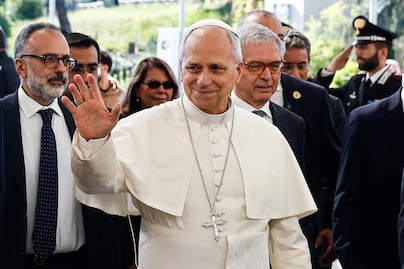
Leo walked into Rome's Gemelli hospital through the main entrance earlier in the day and shook hands with dozens of well-wishers who had gathered to greet him. The Vatican said the surgery would be performed by a team led by Gemelli's head of thoracic surgery, Dr. Stefano Margaritora.
The operation began while medical staff recited the Rosary prayer in the hospital chapel on Tuesday evening. “Let us join in prayer, asking the Lord to sustain our bishop, Pope Leo, and to comfort all those who are hospitalized here,” said the Vicar of Rome, Cardinal Baldassare Reina, at the start of the prayer.
The American pontiff has offered a rare level of transparency regarding the first major publicly disclosed health issue of his 17-month pontificate. He revealed the discovery of the small, localized nodule during his Sunday noon prayer and announced that he would have it removed.
Oncologists say that even if the nodule turns out to be cancerous, Leo's prognosis is “excellent” since it will have been removed at an early stage.
The surgery, which is usually performed under general anesthesia, will require a one-week hospital stay, and the Vatican canceled all of Leo’s audiences through October 20 on Monday.
“These are things that can be treated very well, if the words he used reflect the clinical situation,” said Dr. Lorenzo Spaggiari, director of thoracic surgery at the European Institute of Oncology (IEO) in Milan, who is not involved in the Pope's care but knows the Gemelli team.
But the decision clearly came as a surprise: While the Gemelli has a specific papal apartment that previous popes have used, complete with a private chapel on the tenth floor, Leo will actually stay in a nearby room as the papal apartment is currently under renovation, according to the Vatican press office.
Robotic technology could allow for a biopsy before surgery
Spaggiari said he expected the Gemelli team to perform a biopsy to determine if Leo has lung cancer, followed by the removal of a section or lobe of the lung where the nodule is located.
Both could be done using robotic techniques, and could be performed sequentially, under the same anesthesia, with different teams of specialists, Spaggiari said.
A sophisticated robotic bronchoscopy technology called ION allows for a biopsy on nodules as small as 3 millimeters (1/10 of an inch), Spaggiari said. Both Gemelli and the IEO have the technology, which has been available in Italy for just two years.
Gemelli also has robotic surgical technology, which allows the operation to remove the nodule to proceed “using a minimally invasive technique,” he said.
The technique involves the surgeon making four small incisions in the chest through which the instruments of the so-called Da Vinci robot are inserted, he said. The surgeon then controls the robotic arms by looking at a screen that provides high-definition 3D views.
“It is a very well-established technology. This is something we have been doing for 20 years,” he said.
It was not known for certain which technique would be used on Leo. Gemelli has documented the use of both robotic procedures to diagnose and operate in less than four hours.
The risk of the biopsy is “practically zero,” while the surgical risk is very small, with a mortality rate of 0.6% to 0.8% for patients who are otherwise in good health and have good heart and lung function, Spaggiari said.
Tests will determine if further treatment is needed
During the surgery, doctors would also remove the lymph nodes that drain the segment or lobe. “If all those lymph nodes turn out to be negative, meaning stage one, then the prognosis is very good,” he said, adding that no further treatment would be necessary.
The nodule was discovered during regular check-ups, the Vatican has said.
“I think he has been a bit lucky. They found something that was asymptomatic — a lung nodule, possibly a tumor. He might call it something else; we call it luck,” he said.
Recovery could allow for the November trip to South America
WHAT IS A LUNG NODULE?
A lung nodule is a small abnormal area measuring less than 3 centimeters (1.2 inches) that sometimes appears on a chest or abdomen CT scan. Often, scans are performed to investigate trauma or a lung infection, unrelated to lung cancer screening. A nodule can be benign or malignant, and surgical removal is often recommended both to establish if it is cancer and to treat a malignancy while it is still localized.
It is believed the Pope was hospitalized for typhoid fever in 1985
This is believed to be the second hospitalization for Leo, who is known for being athletic and in good shape, with weekly tennis matches and swimming.
As a young missionary priest, he contracted typhoid fever in 1985, shortly after arriving in Chulucanas, Peru. The illness and hospitalization were a cathartic moment for him to decide to remain in the poverty and discomfort of Peru after living in relative comfort in Rome — a decision that ultimately paved the way for his papacy, according to an interview Leo gave to Elise Ann Allen in 2025 for “Pope Leo XIV: The Biography”.
According to the book, Leo said he prayed to God to let him die rather than suffer the “horrible” pain of the fever. “I was hooked up to an IV, and I said, ‘If this is your sense of humor, Lord, I think you could do a little better.’”
“Obviously, I survived; I recovered, but it turned out to be a very significant moment for me, because it was like: ‘Well, you’ve already dealt with the illness; you see what the needs are here — the order, the Augustinians, the church are telling you: ‘We need you here; go ahead.’ I never looked back.’”

[Publicidad]