

Recommended

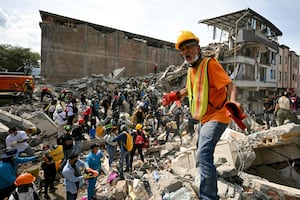
"Welcome to my home," said Fernanda Londoño with a smile as she welcomed the EFE news team while pointing to a tent where she kept her clothes. "Everything I have is here, it's comfortable, forgive me for not having chairs," she added.
What she referred to as "home" measures two square meters and is made of canvas. There, she sleeps, keeps some clothes, and waits, like thousands of families in the Chiminangos neighborhood of Cali, for a fresh start.
The 7.4 magnitude earthquake that shook central and southwestern Colombia eight days ago and left at least 287 dead in the country, 130 of them in Cali, damaged the six-story apartment building where Fernanda lived and prevented her from returning to her home.
"I was with my 84-year-old grandmother and my 18-year-old son, who was on crutches. We were on the second floor, but while going down, it felt like a skyscraper. I got them out as best I could while we watched the earthquake start to damage the walls, how they broke, and how things fell on us," she told EFE.
Although it was 7:34 in the morning, the earthquake occurred under intense sun. For six days, the heat accompanied those who had to leave their homes and get used to sleeping in tents.
However, since Sunday night and throughout this Monday, as the tragedy marks its eight-day anniversary, the rain has joined the new routine: it has been intermittent, it has not stopped, and although it has not been intense, it has been constant.
"I am here alone because I don't want my grandmother or my son to live through this tragedy. They are staying somewhere else, and I am here to be able to support my own," Fernanda recounted.
In some sectors of the neighborhood, collection centers have been improvised to receive water, food, clothing, and other items. In others, community kitchens have been set up, and there are also places where the community receives lunches and meals prepared by citizens, non-governmental organizations, and volunteers.
There are also portable showers, care spaces for pets, and tents where psychologists listen to people who need support to take care of their mental health after having lost almost everything.
"The children try to regain some normalcy among the tents. Some balls serve to play, and educational games have also arrived," Nelcy Mosquera, one of the victims, told EFE, adding that on the day of the earthquake, a woman died inside one of the buildings.
"The neighbors saw it all. While she was going down a staircase, another structure fell on her and ended her life. Since then, every step, every crack, and every noise inside the buildings generates panic," the woman insisted.
Recovering something
Like her, there are hundreds of people who are still waiting to be able to enter their apartments accompanied by experts who determine if it is safe to do so. They want to recover a refrigerator, a washing machine, clothes, documents, or any object that remained inside.
In that popular neighborhood of Cali, those appliances are not just belongings; they are assets that many families obtained after years of work and which they now see from afar, behind buildings they can no longer inhabit or even enter.
Authorities report 43 collapsed buildings, while emergency teams have removed 21,204 tons of rubble. About 1,900 workers remain on the ground attending to different fronts of the emergency.
These are numbers that explain why, eight days later, the city remains full of machinery, rescue teams, tents, and workers.
The emergency has left about 80,000 people affected in Cali, many of them still without a definitive answer as to when they will be able to return to their homes.
"We know this is not a one-day, two-day, or one-week crisis. This is just beginning. That is why many neighbors are saving food so that on the day there is none, we can prepare our own meals," Fernanda added.
For those who lost their homes, the tragedy did not end when the shaking stopped. Now begins another wait: knowing when, how, and where they will be able to start over.

[Publicidad]