

Recommended


The President of Mexico, Claudia Sheinbaum, defended the strength of the national education system this Tuesday despite the negative data from the PISA 2025 report, arguing that the country managed to maintain its performance in science and contain the decline in literacy thanks to the "New Mexican School" model.
"There is a recognition of the role played by teachers, unlike in other countries, and a recognition of the students and their desire to question, which is something very special about the New Mexican School," the president stated in her morning press conference.
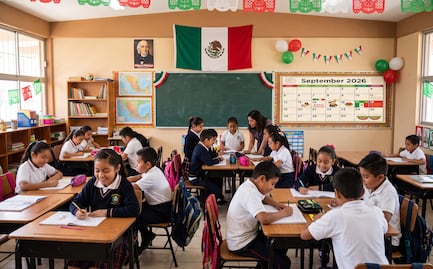

The report reflects notable deficiencies in Mexico in certain fields: seven out of ten Mexican students did not reach the minimum level in mathematics, while five out of ten fell below the basic threshold in reading and science, figures that differ considerably from OECD averages.
Even though more than four out of ten students present a simultaneous lag in the three areas evaluated, Sheinbaum nuanced the results by pointing out that global standardized tests have limitations because they do not consider the "local contexts" and the "social composition" of each country.
"We have always said that the same test for all countries always has its limitations, due to the characteristics of each country. In the case of Mexico, in Science, the score went up. In literacy, it went down in all countries.
The decline in Mexico was smaller than in other countries, and in the case of mathematics, there are also other countries with decreases," she explained.
For his part, and in a message projected during the conference, Andreas Schleicher, Director for Education and Skills at the OECD, confirmed the resilience of the Mexican model by noting that performance in science remained stable since 2022 despite global challenges.


The official also stressed that the education system managed to expand coverage to historically marginalized sectors without widening inequality gaps, highlighting that social inclusion was not accompanied by a deterioration in learning equity.
PISA (Programme for International Student Assessment) is a standardized evaluation promoted by the OECD (Organisation for Economic Co-operation and Development), which measures the competencies of 15-year-old students every three years to evaluate the effectiveness and equity of global educational systems.

[Publicidad]