
Recommended




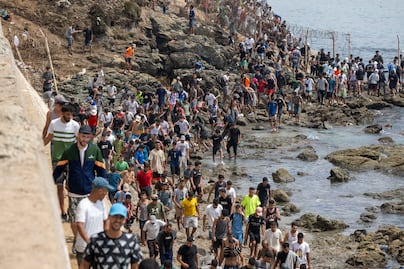
About 60,000 migrants have entered Ceuta from Morocco in the last 24 hours, the president of the Spanish enclave in North Africa said on Friday, a figure that equals 70% of the autonomous city's usual population.
But approximately half of them have already returned voluntarily, the Spanish government reported, after the sudden arrival of so many migrants unleashed chaos and a humanitarian crisis.

Spain deployed its armed forces and additional police personnel to restore order in Ceuta, which is located in the Strait of Gibraltar at the entrance to the Mediterranean Sea and has been a Spanish possession since 1580. On the Moroccan side of the border, security forces clashed with migrants. At least 57 migrants have lost their lives attempting the crossing, including some who drowned or died in a stampede to cross a barrier near a border post.
"The situation in Ceuta is absolutely unsustainable," Juan Jesús Vivas told reporters.
Meanwhile, migrants from Morocco also attempted to enter Melilla, the other Spanish territory in North Africa, where they faced police.

Spanish Prime Minister Pedro Sánchez visited Ceuta on Friday and condemned the breach of the border, calling it "a violation of the country's territorial integrity."
The leader blamed human traffickers who "deceive many young people (...) who meet their death, either in the ocean or, in this case, at the border with Spain in the autonomous city of Ceuta."
The Spanish Interior Ministry, which had initially refused to share estimates from the border, released its own figures shortly after Vivas's statements, estimating that about 50,000 people had crossed from Morocco since Thursday. It added that 37,500 had already returned to Morocco, and that hundreds more were returning every hour.
Video footage of the border showed hundreds of migrants gathered on a hill overlooking Ceuta being dispersed with tear gas by Moroccan forces, while others continued to swim toward Spanish territory. But by Friday afternoon, most of the migrants were trying to leave Ceuta given the desperate conditions there.
Rachid Sbihi, who leads an association of Civil Guard officers, described the situation as a "serious humanitarian crisis," saying that thousands of migrants—including unaccompanied minors—were left sleeping in parks and on sidewalks, while others wandered aimlessly through the streets.
"It's chaotic," Sbihi said.
The Moroccan Interior Ministry has not responded to a request for comment on the migrant figures released by Spanish authorities.
The President of the European Commission, Ursula von der Leyen, stated that the "images arriving from Ceuta are unacceptable."
"We cannot allow anyone to reach our Union without meeting our rules," she said in an online statement. "Dangerous crossings must cease immediately. Trafficking networks must be dismantled. And returns must be rapid, as our rules allow."
Decenas murieron en el caos
Many of the deceased drowned, Sbihi noted, but some also lost their lives in a stampede to cross the breakwater fence at El Tarajal, an urban beach near a border post with Morocco. The waters near the border fence were filled with buoys, shoes, and other abandoned belongings.
Many young Moroccans who crossed into Ceuta told The Associated Press that they hoped to find better job opportunities in Spain, but were returning because of the chaos in Ceuta.
"There is nothing at home. I would have to work 12-hour shifts for a miserable salary. That's why I came here," said 21-year-old Abdulah Buji, originally from Tetuan. "But I haven't found opportunities here either, so I have to go back."
Moroccan police used water cannons and fired warning shots into the air to prevent migrants from crossing into Ceuta, according to human rights groups in Morocco.
"Despite the heavy police presence, people crossed by sea, while the land border remained closed," indicated Achraf Maimouni, a human rights activist in Fnideq, the Moroccan city that borders Ceuta.
The Moroccan ambassador to Spain indicated that the situation in Ceuta had developed against the country's wishes.
"We have always prioritized legal, orderly, and safe migration for everyone," commented Karima Benyaich. She did not comment on the migrants' reasons for crossing into Ceuta.
To reach Ceuta, located on the North African coast, migrants usually swim from the Moroccan city of Fnideq, traveling about 5 kilometers (about 3 miles) to reach Spanish territory. Others attempt to do so from the nearby town of Belyounech, from where the distance is shorter.
Aumento de cruces vinculado a un fallo español
Authorities in both Ceuta and Madrid have linked the increase in crossings to a recent decision by the Spanish Supreme Court, which ruled that those who arrive by sea cannot be immediately deported, unlike those who cross by land or climb the border fence.
Sánchez said that human traffickers misinterpreted the ruling.
"It seems that this reading of the Supreme Court ruling has spread like wildfire over the last few hours through the mafia networks that traffic in human beings and has produced an avalanche of the dimensions we experienced yesterday," stated Sánchez.
But some activists in Morocco expressed doubts that the ruling was behind the increase, claiming that most migrants would not be aware of such legal decisions.

[Publicidad]