
Recommended
A week after the floods that have left more than 1,200 dead in Nepal, a score in China, and more than 5,000 missing, the disaster continues to raise basic questions about what happened and about those who are still unaccounted for.
During the first few days, one of them was how those who made it out of the devastated areas had managed to survive. Now, others have been added, such as where the missing are, why so many bodies remain unrecovered, how the dead are identified, and what happened with an alert that, in some places, left only minutes to escape.
These are some of the key points of a disaster whose toll continues to change seven days later.

What happened in Nepal?
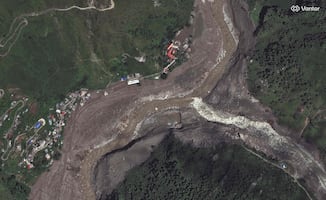
A massive ice and rock avalanche in the upper Bhote Koshi basin, near the border with China, triggered a flood on the morning of August 26 that swept away homes, vehicles, and bridges, struck hydroelectric facilities, and descended through the river system toward other towns.
The speed of the phenomenon was recorded by the instruments themselves. At 8:37 AM, seismic equipment detected a signal initially equivalent to a 4.4 magnitude earthquake, although its frequency did not correspond to a quake, and thirteen minutes later, the flood tore out the Syabrubesi hydrological gauge, whose last reading had been just 1.62 meters, well below alert levels.
Why did some survive and others not in Nepal?
In the first few days, EFE asked survivors how they had managed to get out, and many of the responses were consistent: stop what they were doing, move away from the river, and run toward high ground.
Libes Raj Shakya knew the flood was coming because a friend who had received a call ran through the market shouting for others to flee. "Thanks to him, we knew what was happening, but we only had three minutes to escape," he told EFE.
Others were warned by police, neighbors, or school officials, and most escaped without even enough time to gather their belongings.
A woman interviewed by EFE at a shelter for displaced persons recalled that she left her home empty-handed as the water approached "like a storm."
Why are more than 5,000 people still missing in Nepal?
Among the missing are hydroelectric project workers, inhabitants of devastated towns, and individuals who may have been dragged many kilometers by the current, as authorities continue to refine lists and cross-reference names.
International specialized teams have searched for potential victims in hydroelectric plant tunnels, and in Devighat, EFE found human remains still trapped inside houses several days after the flood.
Where are the dead?
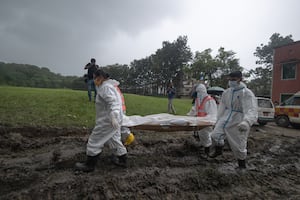
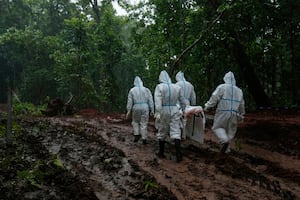
In Devighat, volunteers enter buried homes to recover documents, valuables, and bodies, but some bodies remain trapped even after having been located.
In locations where roads were destroyed, large cargo drones lift them on suspended stretchers and transport them by air to accessible areas. Other bodies have appeared many kilometers downstream, far from the place where the victims were caught by the flood.
How are so many dead being identified?
In a Kathmandu morgue, one wall is covered with photographs of missing persons, and the wall opposite is covered with images of bodies that have not yet been identified.
Police, doctors, and specialists work with the bodies before handing them over to families.
One of the spaces used to store them has a capacity for only about 70 bodies, and the volume of victims also forced burials to be carried out in accordance with legal procedures. Families continue to visit hospitals, police stations, and morgues with photographs of those they are looking for.
Did the alert in Nepal work?
At 8:37 AM, seismic instruments recorded the collapse, although the system did not identify the signal as an earthquake and did not issue a public warning.
At 8:50 AM, the flood tore out the Syabrubesi gauge.
At 9:00 AM, the Rasuwa authorities reported the flooding.
At 9:15 AM, emergency messages began to be sent to Rasuwa, Nuwakot, Dhading, and Chitwan.
38 minutes had passed since the first signal. In Rasuwa, where communications were already affected by the collapse of towers, authorities, police, and neighbors also began to warn people door-to-door.
What is happening now?
More than 5,000 people remain missing, teams continue searching for and recovering bodies, and morgues are working on identification, while hundreds of victims live in shelters after losing their homes.
A week later, Nepal knows much more about how the flood occurred. It still does not know where more than 5,000 people are.

[Publicidad]