

Recommended


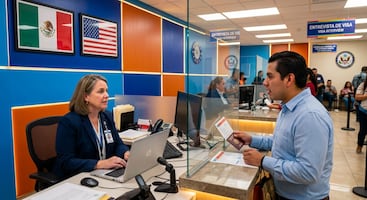
For many applicants, the American visa interview lasts just a few minutes. However, before asking the first question, the consular officer has already reviewed key information from the application and, during the first moments of the conversation, begins to evaluate several elements that can influence the final decision on the visa.
According to the United States Department of State, immigration law establishes that every applicant for a non-immigrant visa is considered a potential immigrant until they prove otherwise. Therefore, the interview is designed to determine if the person meets the requirements of the requested category and if they truly plan to make a temporary visit.
1. Whether your purpose of travel is clear and credible
One of the first things the officer seeks to identify is whether you have a concrete explanation for why you wish to travel to the United States. Tourism, temporary business, family visits, or medical treatment are valid reasons for a B1/B2 visa.
When answers are vague, contradictory, or do not match the information recorded on the DS-160 form, doubts may arise about the true intent of the trip.
2. The consistency between your answers and the DS-160 form
The officer has before them the information you provided in your application. Details such as employment, marital status, travel history, address, education, and reason for the trip have already been reviewed before you approach the window.
For this reason, one of the aspects they can detect almost immediately is if there is any difference between what you wrote on the DS-160 and what you answer during the interview. Inconsistencies usually trigger additional questioning.
3. Your ties to Mexico or your country of residence
Section 214(b) of the Immigration and Nationality Act establishes that it is the applicant's responsibility to demonstrate that they will return to their country after a temporary stay in the United States.
Therefore, the officer pays special attention to factors such as:
- Empleo estable.
- Negocio propio.
- Estudios en curso.
- Familia inmediata.
- Compromisos profesionales o financieros.
These elements help demonstrate that there are significant reasons to return after the trip.
4. Whether your economic situation is consistent with the trip
The officer also quickly evaluates whether the trip you describe seems realistic based on your income and employment situation.
For example, they may analyze who will pay for the trip, how long you plan to stay in the United States, and if the projected expenses are compatible with your economic profile. It is not necessarily about being a wealthy person, but rather that the information makes sense and is consistent.
5. Your immigration and travel history
Other information that appears in consular systems includes previous applications, issued visas, prior denials, and various records related to immigration procedures.
This means that the officer can quickly verify if you have traveled abroad previously, if you respected the conditions of past visas, or if there are records that require further review.

6. Your level of honesty and consistency
The Department of State notes that each application is evaluated individually. During the first moments of the interview, the officer pays attention to the consistency of the answers and ensures that the information provided is truthful.
Lying about employment, income, family members in the United States, or immigration history can become one of the most serious errors within the process. Authorities have access to records and previous applications, so many inconsistencies can be detected quickly.
7. Whether your profile fits a temporary visit
Beyond a single answer, the officer attempts to determine if the entire story presented is logical. The reason for the trip, economic resources, duration of stay, travel background, and ties to the country of residence are part of a comprehensive assessment.
In other words, the main goal is to establish whether the person meets the requirements for a non-immigrant visa and if they will return to their country at the end of their visit, as required by U.S. law.
The visa interview is not based solely on the answers you give at the window. When the conversation begins, the consular officer has already reviewed much of your information and uses those first few seconds to confirm that your story is coherent, credible, and compatible with a temporary visit to the United States. Clarity, honesty, and consistency remain some of the most important factors for any applicant.
Be part of our WhatsApp channel. VIVE USA is now available! Stay informed from your mobile device about the most relevant news regarding travel, work, life in the United States and Canada, celebrities, trends, and much more.

[Publicidad]