

Recommended
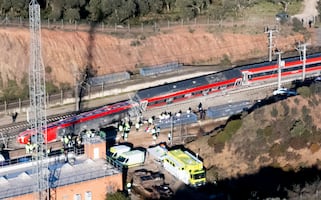


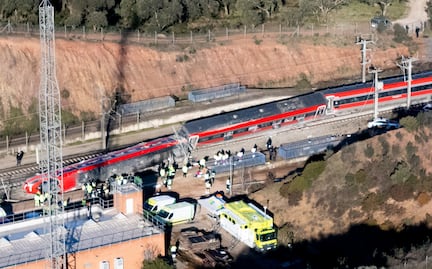
The investigation into the rail accident in Adamuz, Córdoba (south-central Spain), which has left at least 40 dead, is focusing on a break in a section of the track, which may be the "cause or consequence" of the incident, although efforts are still centered on recovering the two Alvia train carriages that plunged down an embankment.
Technical rescue teams have begun installing a large crane to lift the carriages of the wrecked Alvia train, though the task will be slow due to the amount of debris to be cleared, and there are fears of finding more fatalities in those two carriages, reported the president of the Regional Government of Andalusia, Juanma Moreno.

¿Cuántos heridos dejó el accidente de tren en España?
Additionally, a total of 41 people remain hospitalized, while 43 missing person reports have been filed at police stations in Huelva, Madrid, Málaga, Córdoba, and Seville. The Institute of Legal Medicine of Córdoba has already received the bodies of 37 deceased and forensic experts have performed 23 autopsies, reported the Integrated Data Center (CID) through the High Court of Justice of Andalusia.
Transport Minister Óscar Puente explained that the investigation must determine whether the break in a section of the track is "the cause or the consequence" of the Iryo train derailment that led to the collision with the Alvia train, although he acknowledged that the gap is "very large."
Puente indicated that the Railway Accident Investigation Commission (CIAF) is in the data collection phase and any hypothesis is "speculation, like many others."
¿Cómo fue el descarrilamiento del tren en España?
In its initial description of events, the investigative commission points out that an Iryo train derailed, causing the last two carriages of the train to encroach upon the adjacent track.

Twenty seconds later, an Alvia train arrived on that track, and its first two carriages collided with the last two of the Iryo, causing those first Alvia carriages to fall down a four-meter embankment.
The CIAF, for its part, requested from Adif the circulation records for Adamuz for the two days prior to the accident and will inspect the wheelsets of other trains that traveled through that point in the hours leading up to the incident.
According to a statement from the Ministry of Transport, the commission has determined that, in addition to inspecting the wheelsets of the Iryo train in a workshop, the rails at the point where the derailment began will also be analyzed in a laboratory.
The investigation will also extract data from the legal recorders (the 'black boxes') of both trains, which will be transported to CIAF facilities in Madrid before being taken to a laboratory.
The wrecked Iryo train had been inspected on January 15, three days before the accident that forced the suspension of the high-speed rail connection. Its full resumption is expected for February 2, although work is underway to enable one of the two tracks "as soon as possible to allow traffic for a few days," according to Puente.
¿Cuál es la postura de las autoridades españolas tras colisión de los trenes en Adamuz?
"It was not a problem of speeding and it was a straight track, not a curve. Drawing conclusions will not be immediate," said Renfe president Álvaro Fernández Heredia, who pointed to a problem with the tracks or the trains and did not rule out human error.
As he explained, it is a track that had been repaired in May and "should be in optimal condition"; it is also equipped with an LZB safety and signaling system, which "basically prevents human error."

"When the LZB detects an obstacle on the track, it activates automatic braking (...). Apparently, the time interval between one train and another crossing in the opposite direction was 20 seconds, and therefore, it is impossible for the mechanism to act," he indicated.
Since last spring, the railway infrastructure manager, Adif, has reported at least eight incidents in Adamuz related to the catenary, signaling, and the infrastructure itself, among others.

[Publicidad]