

Recommended
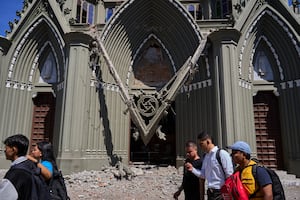
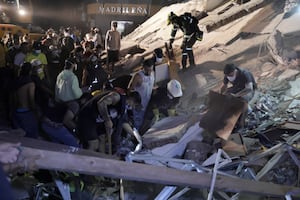

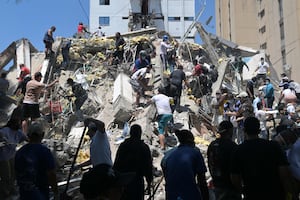
The earthquake that has shaken Colombia is a subduction earthquake that is "quite complex and will need to be studied in depth" due to the substantial damage caused despite its great depth (100 km), and which shares a "tectonic context" with those in Venezuela last June.
This was stated on Tuesday in an interview with EFE by Raúl Pérez, from the Geological and Mining Institute of Spain (IGME), who explained that this latest 7.4 magnitude phenomenon that occurred on Monday "corresponds to the subduction zone between the Nazca tectonic plate and the South American plate."
- TAMBIÉN LEE: Sismo de 7.4 en Colombia: México enviará 255 militares y toneladas de ayuda humanitaria
The tremor, whose epicenter was located in the town of San José del Palmar, in the department of Chocó (in the Pacific region), and one of the most significant recorded in that country in recent years, is considered a "strike-slip earthquake," according to tectonic and geological analyses.
FOTOS SISMO EN COLOMBIA
And an earthquake of that type "at that depth is usually quite complicated, complex, which means it will have to be studied quite thoroughly," the geologist maintained.
Similitudes y diferencias con Venezuela
This natural disaster occurs while the impact of the recent and devastating earthquakes that occurred in Venezuela on June 24 is still fresh in memory. Regarding this, Pérez pointed out that "the tectonic context is the same, at the boundary between the Caribbean plate and the South American plate."
"If we follow the fault that caused the Venezuela earthquake towards the west and downwards, we would connect with the area where these earthquakes have occurred," he observed. And despite this similarity, he points out that there are two elements that distinguish them "quite a bit."
In the first place, those in Venezuela occurred "at a depth of 10 km and the Colombia earthquake was at a depth of 100 km; and, secondly, they are separated by epicenters about 1000 km apart."
Although both are differentiated by "their depth and physical distance," in both cases the "same tectonic context is identified, exactly the same, with the Venezuelan part interacting with the Caribbean plate and, on the Colombian side, interacting with the Nazca plate."
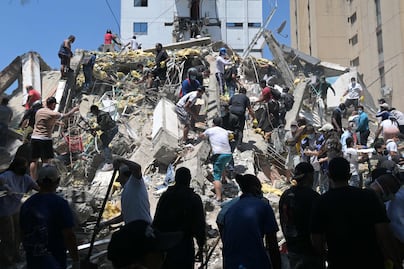
Efecto de sitio
In Colombia, the tremor was felt for a longer time in some areas due to what is known as the "site effect." This occurs "when the mechanical and geological properties of the terrain through which the seismic wave passes amplify the frequency and amplify the amplitude of the wave." And, furthermore, "it amplifies the damage it can cause to buildings located on this terrain," he detailed.
Another "interesting" factor in this latest earthquake in Colombia is that "it has caused quite a bit of damage for being at a depth of 100 km" since it is "very difficult for strike-slip earthquakes to nucleate at these depths."
Réplicas y efecto de cascada
The seismologist believes that vigilance must now be maintained and indicated the sequence that experts trace when these phenomena occur.
"Since we cannot predict earthquakes, the first thing we do is detect them and once we have detected them, we have to assign them a source; see which fault or structure is responsible for the terrain," he noted.
Next, it is determined how that fault has moved in order to establish the tectonic context and observe if it can stimulate surrounding faults and calculate the probability of a strong aftershock. Afterward, the wave propagation and site effect in the nearby towns are established with the goal of improving earthquake-resistant codes in buildings constructed subsequently.
In Colombia, experts still anticipate new aftershocks since "not even 24 hours have passed" but they believe that due to its great depth "they will not be like those produced in Venezuela, which had a significant effect on the buildings that were affected by the main earthquake."
It is now also essential to remain alert to the possible "cascading effect," as this earthquake has affected a volcano located nearby, the Puracé, which is in moderate activity and "has been activated a little."

[Publicidad]