

Recommended
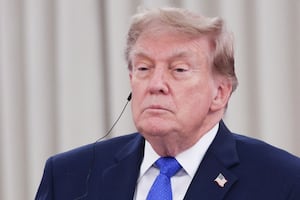
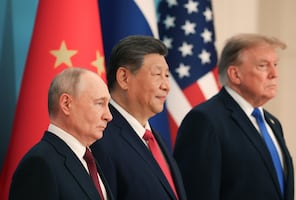
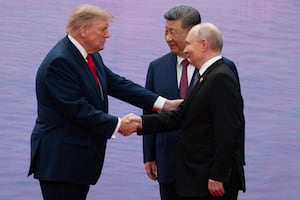
Russian President Vladimir Putin stated that he would like to repeat in the future the historic summit he held this Thursday with the leaders of the US, Donald Trump, and China, Xi Jinping, while inviting European representatives to visit Moscow to explain their vision for the settlement in Ukraine.
- TAMBIÉN LEE: Trump se "duerme" durante discurso de Xi Jinping y desata críticas: “El peor presidente en la historia”
"This has been a page in the history of diplomacy," he said at a press conference in the Chinese city of Shenzhen at the end of his participation in the tripartite summit, which he compared to the 1945 Yalta Conference, on the eve of the end of World War II, where the division of the world between the great victors of the conflict, the United States and the USSR, was determined.
Putin insistently denied that the meeting was "for show"—in fact, he described it as "very useful"—although he also admitted that it cannot yet be considered an established format, as it would need to have continuity.
Recommended
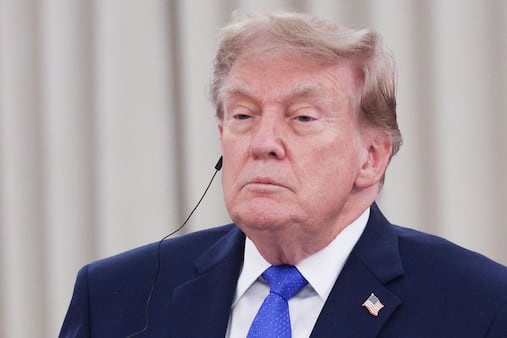
Trump se "duerme" durante discurso de Xi Jinping y desata críticas: “El peor presidente en la historia”
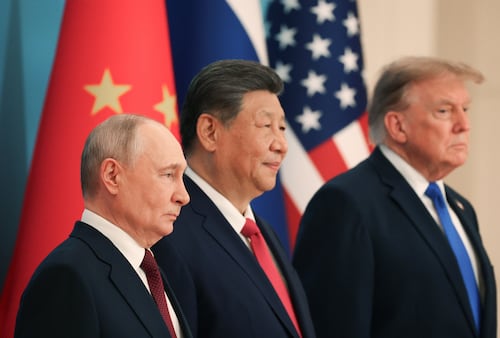
Trump, Putin y Xi Jinping anuncian una “declaración de paz” tras histórica cumbre en China
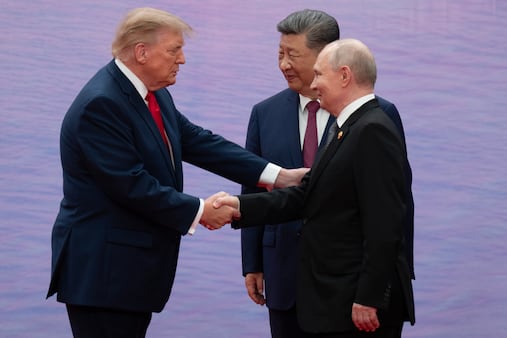
¿El maletín nuclear de Putin puede lanzar bombas atómicas? Esto es lo que realmente hace
Gobierno de Trump descarta ciberataques en Estados Unidos tras fallas en vuelos, bancos y la NSA
Yalta 2.0, ARE THEY DIVIDING THE WORLD?
Both at the beginning of the meeting and during his encounter with the press, reporters asked him about the parallel to the conference held in February 1945 on the Crimean peninsula with the participation of Soviet leader Joseph Stalin, US President Franklin D. Roosevelt, and British Prime Minister Winston Churchill.
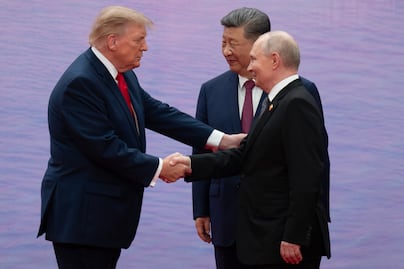
In Putin's opinion, "at Yalta, no one divided up the world (...) There was no division of spheres of influence. Only the reality created after World War II was established. And in today's conflicts, we will also have to accept reality," he said, alluding to Ukraine.
He added that at Yalta, "victory over Nazism was established. I would not be against it. (In fact,) I consider it would be correct to fix the victory over neo-Nazism."
"Was there anything bad about Yalta? (...) It was a miracle," he asked.
He recalled that at that conference it was decided to found the UN and "for 80 years, thanks to those agreements, in essence, the world has lived without major global military cataclysms."
"Yes, there are many regional conflicts, and they are underway now, but not global ones," he noted.
Europeans are invited to Moscow
In turn, he announced that Russia has invited representatives of the European Union (EU) to Moscow to explain the agenda with which they would participate in future rounds of peace negotiations with Ukraine.
"We have to understand with what (agenda) Europe is going to participate in those (peace) negotiations. Therefore, through diplomatic channels, we have proposed that the Europeans come to Moscow so that we can understand their position," he revealed.
All in all, Putin has not yet given his approval for the EU to have a seat in future rounds, as he accuses it of being part of the conflict by supplying weaponry to the Ukrainian side.
Furthermore, he said he had accepted Washington's proposals to integrate Ukraine's security into the framework of continental security architecture.
"Ukraine's security must be integrated into European security, but it is evident that talking about European security without Europe would also be something strange," he clarified, adding that Russia has no intention of "sacrificing anything," but rather of achieving "compromises."
The date for a new round of peace negotiations between Russia and Ukraine has not yet been set. But European leaders have already agreed that the delegation will be formed by the institutions of the European Union and the E5 (Germany, France, Italy, Poland, and the United Kingdom).
Putin tells Trump and Xi he does not want to keep fighting
Putin stated he had told Trump and Xi that Russia also wants to end the war. "The presidents spoke of their interest in ending the conflict in Ukraine. Russia is also interested. I assure you. We have no desire to continue this armed conflict," he stressed.
But, as is customary, he immediately insisted on the idea that the Russian Army did not start the current war, but is instead "trying to end" the conflict that broke out in 2014 in the Donbas almost five years ago.
He underscored that the problem lies in the Ukrainian position, which refuses to accept the "compromises" proposed to it at the time by the United States after the Russo-American summit of August 2025 in Anchorage. "We accepted them and now it is Ukraine's turn," he noted.
In this regard, he added that Kyiv is mistaken in trying to maintain at all costs control of the 10%—or 20%, according to Western sources—that it still occupies in the Ukrainian region of Donetsk.
"Everyone will have to accept the reality (on the ground) (...) Let's hope we reach an agreement," he stated.
Regarding security guarantees, he noted: "We recognize that Ukraine has a right to its security, just as Russia does. Simply put, Russia's security must be guaranteed."
"We accepted the proposal from the American negotiators that Ukraine's security should be integrated into common European security. What is wrong with that?" he pointed out.

[Publicidad]