

Recommended




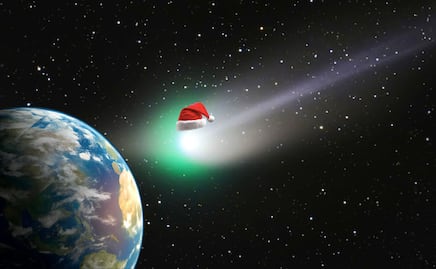
Astronomers around the world, amateur photographers, and space enthusiasts are striving to spot the comet 3I/ATLAS, as it is scheduled to visit Earth this Friday, December 19, 2025, during its perigee, which will be its closest approach to us.
While the planetary defense exercise by the International Asteroid Warning Network, coordinated by NASA and the UN, will be monitoring it while investigating it further to inform us of every detail of its nature, we will be able to observe the interstellar object with our own equipment and marvel at this once-in-a-lifetime event.
¿Cómo observar el cometa 3I/ATLAS a su paso por la Tierra?
Major space agencies such as NASA and the ESA will also capture and photograph it to share their best images, but in the meantime, we have a few options to observe it live.
- NO TE PIERDAS: 3I/ATLAS se acerca a nosotros y la ONU y la NASA ponen en marcha su defensa planetaria
The online simulation "Eyes on the Solar System" from NASA is one of the main tools that will help us follow 3I/ATLAS through its perigee. Eyes on the Solar System shows the current location and trajectory of 3I/ATLAS as it moves through our Solar System. This platform is available in English on the agency's website.
For its part, the Virtual Telescope Project will also broadcast it live starting at 10:00 PM CST (Central Standard Time), which is the same time as in Mexico.
Aside from live streams, we will be able to observe the comet with binoculars and wide-range telescopes from various points on Earth, including Mexico.
It is estimated that the best viewing time will be before dawn. Although its closest approach will be on December 19, at a distance of 270 million kilometers from us, 3I/ATLAS will remain observable until the Northern spring of 2026.
¿Hay peligro de que el 3I/ATLAS choque con la Tierra en su acercamiento?
NASA assures that it poses no danger to humanity due to the distance at which it will pass by Earth.
Furthermore, despite the theories that have emerged since its discovery in July regarding its extraterrestrial origin and artificial control, the agency itself has stated that the interstellar object is a conventional comet, originating from somewhere in the deep universe, and that when its trajectory within the Solar System concludes, it will leave and not return for millions of years.
This means there is no possibility that the object will threaten humanity, as suggested by Avi Loeb, an expert from Harvard University in his dozens of theories, or change the perspective of our place within the universe.



[Publicidad]