

Recommended
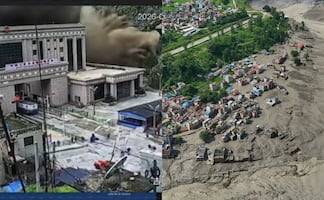




At least 98 people died this Wednesday due to a devastating river flood in an area on the border between Nepal and China, which left hundreds missing, many of them foreign tourists.
A torrent of mud and debris overflowed from a river, burying buildings and triggering a frantic search to find survivors among the rubble.
Nepal police reported that there are 95 dead and nearly 28 personnel missing as rescuers make their way through the water and mud to find survivors.
Chinese state media reported "numerous casualties" after the catastrophe and later gave a preliminary toll of 3 dead and 265 missing.
It was not immediately clear if there was any overlap between the Chinese figures and those announced by Nepal, as the Chinese state broadcaster CCTV indicated that the specific victim data is still being verified.
In images shared by the Nepal police, an overflowing river could be seen sweeping away several houses in the Rasuwa district.
In another image, taken by the AFP, a home surrounded by mud could be seen.
"I saw how the waters took away eight or nine trucks, as well as houses and people," said Suman Chalise, a 34-year-old teacher, in the Nepalese town of Nuwakot.
"It was absolutely heartbreaking (...) I witnessed devastation of such magnitude that I had never seen anything like it," he added.
The Ministry of Culture, Tourism and Civil Aviation of Nepal reported that nearly 403 tourists, 341 of them foreigners, remain unaccounted for.
The Nepal Tourism Board reported that among this group are Americans, Indians, Malaysians, British, and an Australian, in addition to 62 Nepalese travelers.
The flood hit Syabrubesi, the starting point for the popular Langtang hiking trail, as well as other areas used by travelers for the Hindu pilgrimage to Kailash Mansarovar.-
"Numerous casualties"
The cause of the floods is not clear, but the Foreign Minister of Nepal, Shishir Khanal, stated that a quake likely triggered a landslide which, in turn, blocked a river, causing the water levels to rise.
The National Disaster Risk Reduction and Management Authority noted that satellite data from Planet Labs indicates that a "snow and rock slide" on the border between Nepal and China could have caused the floods.
The Nepalese Army is conducting aerial searches and rescued 114 people from the Rasuwa district, one of the most affected areas, the government reported.
The Prime Minister of Nepal, Balendra Shah, made a call for unity but also asked the population for "patience."
"I want to assure you that you are not alone in these difficult times: the State is with you with all its means and resources," Shah affirmed in a statement published on social media.
"Please be patient. The Government assumes full responsibility for your rescue, medical care, food, and shelter. In times of a catastrophe like this, we must all remain united," he added.
A police spokesperson had told the AFP that the authorities did not know the extent of the damage, but assured that they had "alerted people who are near the river bank to move away."
Raju Bhadel, 56, said he received a call from his brother-in-law during the morning. "
They were crying and said their house was washed away. Three family members were rescued, but his brother is still missing," he said.
The Chinese state broadcaster CCTV reported on Wednesday that "a landslide on the Nepalese side caused numerous casualties and missing persons at the Gyirong port," the pass that connects the Tibet Autonomous Region with Nepal.
The Chinese President stated that "the most urgent task is to do everything possible to search for and rescue the missing persons (...) quickly attend to the injured and minimize the number of casualties," reported CCTV.
Floods and landslides are frequent during the monsoon season in the northern summer in Nepal and throughout South Asia. According to scientists, climate change increases the intensity and frequency of these types of phenomena.

[Publicidad]