

Recommended
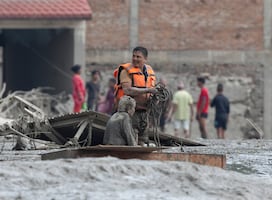
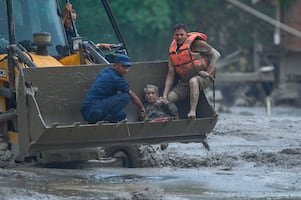
This Wednesday, a flash flood occurred in Nepal that has left about a hundred people dead so far and more than 900 missing, according to EFE. In the videos circulating on social media, the scale of the disaster can be seen: a large-scale flood that wiped out entire villages and infrastructure. But what is this phenomenon, why is it so devastating, and what caused it in Nepal? We tell you here.
What is a flash flood?
A flash flood is described by the site inundation.es as "an arrival of water flow from upstream, which 'comes toward' the position of the observer" and occurs "suddenly, abruptly, and even impetuously."
Furthermore, this phenomenon is characterized by occurring in "small torrential mountain basins (ravines and streams) and the Mediterranean coast (gullies and creeks)."
According to the United States National Weather Service, flash floods occur "after torrential rains, the failure of a dam or levee, or the sudden release of water held back by an ice jam."
Why are flash floods so devastating?
Flash floods can have destructive effects due to the force and speed at which the water moves. "They can roll boulders, tear out trees, destroy buildings and bridges, and scour out new channels," according to the United States National Weather Service.
In addition, the water "can reach heights of 9 meters or more" and "trigger catastrophic mudslides."
On the other hand, there is no time for the population to take measures or react, as "you don't always get a warning that these deadly flash floods are coming."
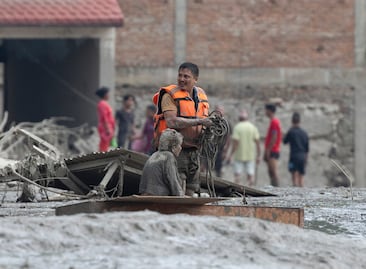
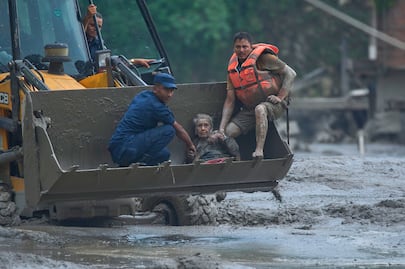
What caused the flash flood in Nepal?
According to EFE, the origin of the flash flood in Nepal is still being evaluated. In an initial report, it was stated that it could have originated from "an overflow or rupture of a glacial lake in Tibet."
Later, it was suggested that the flash flood could have been caused by an earthquake that occurred at 8:37 local time.
This magnitude 4.4 earthquake, recorded by the United States Geological Survey, had an epicenter about 77 kilometers northwest of the Nepalese town of Kodari and a depth of 10 kilometers.
According to the Foreign Minister of Nepal, Shishir Khanal, the earthquake "likely triggered a large landslide, blocking the river's course and subsequently causing the flood."

[Publicidad]