

Recommended














Look up at the sky! Today, Tuesday, November 24, the night will be illuminated by a Supermoon, the second of the year, which promises to be a spectacle for lovers of astronomy and the wonders of the dark sky.
Why is it called a Supermoon?
The Supermoon will also be a full moon, popularly known as the Beaver Moon. It is called a Supermoon due to the distance at which it will be positioned in relation to Earth.
- LEE MÁS: Mamá de Vadhir Derbez rompe el silencio en redes: “Los rumores los inician los resentidos…”
- NO TE PIERDAS: ¿Los extraterrestres viven entre nosotros? Exfuncionario militar de Estados Unidos lanza una inquietante teoría
According to scientists, it is estimated that the Moon will be at a distance of 360,765 kilometers from Earth at its perigee position, which will make it look larger and brighter than usual. The average distance is 384,400 kilometers.
Recommended

"No olvidaré sus ojos amenazantes y seductores": Papa Francisco reveló que vio al diablo en tres ocasiones

Asaltan residencia de los príncipes William y Kate Middleton en Norfolk: hay dos detenidos

Thanksgiving 2026: ¿Qué tiendas estarán abiertas y cuáles cerradas este Día de Acción de Gracias?

Visa negada en menos de dos minutos: las señales que llevan al cónsul a tomar una decisión rápida

Canadá Rural y Atlántico: los programas poco conocidos que facilitan la migración de mexicanos

Elizabeth Hurley desata revuelo con vestido de transparencias en boda de Miley Cyrus

Día de Acción de Gracias: ¿por qué no se celebra Thanksgiving en México como en Estados Unidos?

Bienestar Edomex abre registro para mujeres de 18 a 64 años: cómo recibir consultas, medicamentos y lentes gratis

Alexandr Wang, director en Meta, advierte sobre la IA: "Una mente alienígena que no comprendemos"

¿Por qué Christian Nodal dejaría de cantar en México? Esto se sabe tras su mensaje de despedida

Padre de Meghan Markle habría viajado a Asia para conocer "chicas jóvenes", revela su hijastro

Thanksgiving 2026: ¿Cuáles serán los días de mayor tráfico en aeropuertos de Estados Unidos?
The name Beaver comes from names established by the influence of different places, Native American and European influences. The names of the Moon do not only apply to the phenomenon of one day, but to the entire lunar month, explains The Almanac.
The November Moon receives this name because it is the time of year when beavers begin to take shelter in their lodges with enough food supplies for the coming winter in the Northern Hemisphere.


In addition to this, November is the season for the beaver fur trade in North America, notes NASA, prior to the winter frosts.
What time will the 2026 Beaver Supermoon rise? Will it be visible from Mexico?
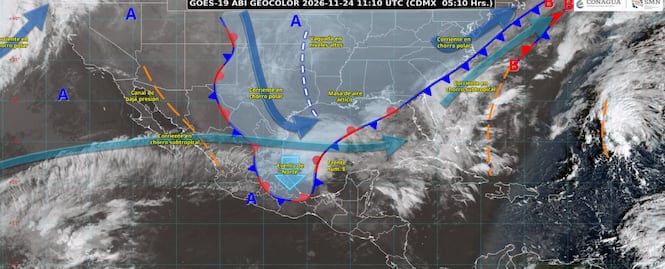
The Moon will reach its full phase this Tuesday, November 24, 2026, at 9:53 pm Central Mexican time. If weather conditions permit, the phenomenon will be visible in much of the country and in Mexico City.
Beyond its peak, the November Moon will continue to look bright and close in the days that follow.
The Supermoon and the Pleiades together at the same time
In addition to the full moon, the sky will be adorned with the Pleiades star cluster, which will be positioned near the Moon from our perspective, above the constellation Taurus. Scientifically, this cluster is one of the most striking and beautiful to appreciate. Also, the Moon will be near the planet Uranus.
Experts recommend using telescopes or binoculars to enlarge space objects and view them with ease, especially because the brightness of the Supermoon could hinder their visibility.


[Publicidad]