

Recommended







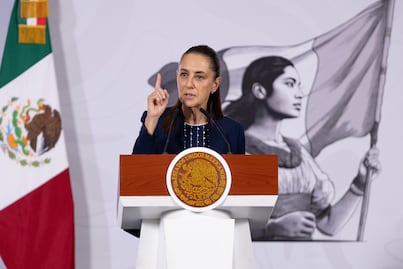
The President of Mexico, Claudia Sheinbaum, concluded the football World Cup in the country, which took place in three cities, recognizing this Tuesday the 124,000 personnel who were part of the security plan for the tournament, known as the Kukulkán Plan.
"The success of the football World Cup is not only measured by the matches, the full stadiums, or the images that travel the world; it is also measured by a country's capacity to organize, to coordinate, to work united around a common goal, and that is what Mexico achieved," stated the Mexican leader.
During the ceremony held in the central State of Mexico, the head of the Executive, accompanied by representatives of the Mexican government and foreign ministries from Europe, Africa, Asia, and South America, highlighted that the country demonstrated both on and off the field "its generosity and pride in its roots."
She also thanked the Mexican Army, which had the participation of 20,734 troops during the implementation of the Kukulkán Plan, which took place from January 2025 to July 19, 2026, with the coordination of FIFA representatives.


Sheinbaum also took the opportunity to once again congratulate the Mexican National Team "for the joy it gave the people of Mexico."
"For their passion, for defending the colors of Mexico with dignity, because beyond the sporting result, they reminded us that when you play with your heart, you always represent our country with honor," she highlighted.
For his part, the Secretary of Security and Citizen Protection of Mexico (SSPC), Omar García Harfuch, pointed out that one of the pillars of the aforementioned plan was the coordination of the 23 technical working groups.
He explained that, based on these groups, protocols were designed for "the protection of stadiums, strategic infrastructure, mobility routes, access control, crowd management, and emergency response."

Likewise, he specified that at the municipal level, more than 90,500 members of the corporations of Jalisco, Nuevo León, Quintana Roo, State of Mexico, Mexico City, Hidalgo, and Baja California were deployed.
In total, the Kukulkán Plan involved the participation of 124,000 personnel from security institutions of the three levels of the Mexican government, as well as coordination between 16 government ministries, 26 federal agencies, and 6 state governments organized into 23 technical groups.
The Government of Mexico also asserted that the celebration of 13 matches and the presence of 17 teams, which played and trained in the country, boosted the national economy, as businesses recorded an increase in sales of between 10% and 15%.
Mexico has hosted the World Cup three times, and for the first time, three of its cities did so: Guadalajara, Nuevo León, and Mexico City.
In the latter, five deaths were recorded during activities related to the World Cup; four of them died from asphyxiation during crowds on Paseo de la Reforma avenue, but none of the victims were mentioned in this Tuesday's event.


[Publicidad]