

Recommended









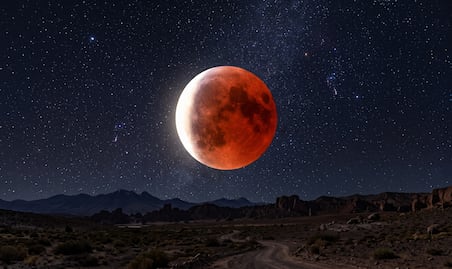
Between the night of August 27 and the early morning of August 28, one of the most anticipated phenomena for science and astronomy fans will occur: a partial lunar eclipse that will appear as a Blood Moon.
This phenomenon will be visible across various latitudes of the American continent, including Mexico. It is estimated that the partial lunar eclipse and the Blood Moon will occur during the night of the 27th and the early hours of August 28th, specifically between 7:23 pm Thursday and 1 am Friday, Mexico Central Time.
During the eclipse, the Moon will be in its full phase and will turn an intense red due to the shadow cast by the Earth. It is worth noting that this phenomenon will cover 96.2 percent of the lunar disk, so it will not be a total eclipse.
- LEE MÁS: Riada en Nepal: ¿qué es y por qué fue tan devastadora? VIDEO
- NO TE PIERDAS: Colombia activa evacuaciones tras un sismo de 5.1: Bogotá y Bucaramanga sienten el temblor
Can the Moon cause earthquakes?
Around this astronomical event, questions have arisen about its effects on Earth: Can an eclipse, the position, or the phase of the Moon trigger an earthquake? Below, we tell you what science has to say.
Earthquakes cannot be predicted, nor is there data to confirm or detail significant correlations between the frequency and magnitude of earthquakes and the Moon or eclipses.
Experts from the United States Geological Survey (USGS) point out that earthquakes have the same probability of occurring in the morning, afternoon, or night, although there may be some influence from Earth tides on the development of seismic movements.

According to the USGS, there is a higher chance of an earthquake occurring on "shallow thrust faults near continental edges and in subduction zones" during a full or new Moon.
Earth and ocean tides can slightly modify the pressure on some geological faults and, therefore, influence the probability of an earthquake occurring, experts explain. When confining pressure decreases, certain shallow faults can slip more easily.
Although some studies have found an increase in probability during certain tidal phases, the absolute risk remains very low, meaning tides do not allow for the prediction of earthquakes. This influence is mainly due to the gravity of the Moon and the Sun, which generate variations in the forces acting upon the Earth.
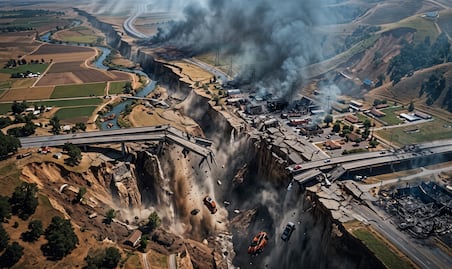
Falla de San Andrés: ¿se acerca un gran terremoto? Detectan movimiento constante durante 10 mil años
Regarding lunar eclipses like the one on August 27, or solar eclipses, the USGS states that they "do not cause special tidal effects" different from those of a full or new Moon.
Can solar storms cause earthquakes?
The USGS points out that it has not been scientifically proven that space weather—the term used for phenomena like magnetic storms or solar flares—interferes with the movement of tectonic plates.
Earthquakes will continue to occur in different parts of the world even when there are no changes in space weather, because seismic movement originates in the interior of the Earth and is unrelated to space.
What is a Blood Moon?
The United States National Aeronautics and Space Administration (NASA) explains that the phenomenon will appear as a Blood Moon because our planet prevents most sunlight from reaching the Moon.
The light that manages to get through is filtered through a layer of the Earth's atmosphere on its way to the lunar surface.
For this to happen, there must first be a lunar eclipse, which is when the Earth, Moon, and Sun align so that the Moon passes through the Earth's shadow. When a lunar eclipse occurs, the Moon sits within the darkest part of the Earth's shadow, called the umbra.
"When the Moon is inside the umbra, it turns a reddish-orange color. Lunar eclipses are sometimes known as Blood Moons due to this phenomenon," explains NASA.




[Publicidad]