

Recommended
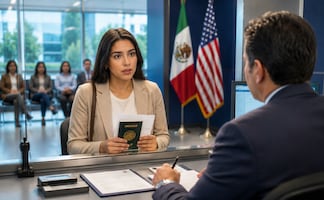


Receiving a denial on the US visa application can be a discouraging experience, especially when there are family, tourism, or business plans that depend on that document. However, a rejection does not necessarily mean that the door to the United States is closed forever. In many cases, understanding why the visa was denied and making adjustments before reapplying can significantly increase the chances of success in a future interview.
The key is to identify the reason for the denial, strengthen the aspects that raised doubts for the consular officer, and present a more solid and coherent application.
¿Quién decide si te aprueban la visa americana?
The final decision rests with a consular officer during the interview held at the United States embassy or consulate.
During the appointment, the official reviews the information provided in the DS-160 form and evaluates various factors such as:
- Situación laboral.
- Ingresos y estabilidad financiera.
- Motivos del viaje.
- Historial migratorio.
- Vínculos familiares y económicos con el país de origen.
Based on this evaluation, the officer determines whether the applicant meets the requirements to receive a non-immigrant visa.

¿Un rechazo de visa es definitivo?
Not necessarily. Most people can submit an application again. However, before doing so, it is essential to understand the cause of the denial to avoid repeating the same mistakes.
There are different types of rejection and each requires a different strategy to resolve it.
Rechazo bajo la sección 221(g): cuando falta información
One of the most common reasons for a temporary denial is section 221(g) of the Immigration and Nationality Act.
This type of rejection generally means that the process is incomplete or that the authorities need additional information before making a final decision.
The most frequent reasons are:
- Datos incompletos en el formulario DS-160.
- Documentación faltante.
- Dudas sobre la elegibilidad del solicitante.
- Necesidad de un procesamiento administrativo adicional.
In these cases, the consulate usually indicates which documents are missing or what steps must be followed to continue with the process. Although many cases are resolved in less than 60 days, some can extend for several months.
Rechazo bajo la sección 214(b): la negativa más frecuente
Section 214(b) is one of the most common causes of rejection for those applying for a tourist or business visa.
This occurs when the consular officer considers that the applicant failed to demonstrate sufficiently strong ties to their home country or did not convince the authorities that they will return at the end of their trip.
Among the situations that usually raise doubts are:
- No tener empleo estable.
- Carecer de ingresos comprobables.
- No estudiar ni desarrollar una actividad profesional.
- Tener planes de viaje poco claros.
- No demostrar propiedades, negocios o responsabilidades familiares.
When a visa is denied under this section, the applicant can apply again, but must complete a new DS-160 application and pay the corresponding fee again.
¿Qué son los "lazos fuertes" con México?
One of the most important concepts during any visa interview is that of strong ties to the country of origin.
US authorities consider that a person has solid ties when they have clear reasons to return to Mexico after a temporary stay in the United States.
Some examples include:
- Un empleo formal y estable.
- Estudios universitarios o académicos en curso.
- Propiedades inmobiliarias.
- Negocios o empresas propias.
- Familia directa que depende del solicitante.
- Compromisos financieros o profesionales en México.
The more elements there are that demonstrate roots in the country, the greater the chances of convincing the consular officer that the trip will be temporary.
Cómo demostrar lazos fuertes en la entrevista
Everything starts with the DS-160 form.
The information included in this document will serve as the basis for the questions the consular officer will ask, so it is essential to fill it out carefully and without omitting relevant details.
When completing the form, it is recommended to include precise information about:
- Empleo actual.
- Salario.
- Estudios.
- Negocios propios.
- Propiedades.
- Itinerario de viaje.
- Motivo específico de la visita a Estados Unidos.
During the interview, the answers must match what was declared on the DS-160. Contradictions can raise doubts and negatively affect the evaluation of the case.
Documentos que pueden ayudar a respaldar tu solicitud
Although they are not always requested during the interview, having supporting documentation can be useful if the officer needs to clarify any aspect.
Employment evidence
- Carta del empleador.
- Constancia laboral.
- Credencial de trabajo.
- Recibos o comprobantes de nómina.
Financial evidence
- Estados de cuenta bancarios.
- Declaraciones fiscales.
- Comprobantes de ahorro o inversiones.
Proof of residence
- Comprobantes de domicilio.
- Escrituras o contratos de vivienda.
- Recibos de servicios.
Academic evidence
- Credencial escolar.
- Constancia de inscripción.
- Carta de la institución educativa.
Travel evidence
- Reservas.
- Itinerario detallado.
- Información de los lugares que se visitarán.
- Motivos específicos del viaje.
A clear itinerary usually generates more trust than vague answers like "I'm going to visit the United States".
¿Cuánto tiempo conviene esperar antes de volver a solicitar la visa?
There is no mandatory period to submit a new application.
However, doing so immediately after a rejection, without anything having changed in the applicant's personal, work, or financial situation, usually increases the risk of receiving another denial.
It is best to wait until you can demonstrate significant changes. For example:
- Conseguir un empleo estable.
- Incrementar ingresos.
- Iniciar o concluir estudios.
- Adquirir una propiedad.
- Fortalecer el historial financiero.
Casos más complejos: rechazos prolongados o permanentes
There are situations in which the rejection can be more difficult to overcome.
Presencia ilegal en Estados Unidos
People who remained in US territory without authorization may face immigration restrictions and, in some cases, need to apply for a pardon or waiver before applying again.
Delitos graves
Some causes of inadmissibility related to serious criminal activities can result in long-term or even permanent impediments to obtaining a visa.
Consejos para aumentar las posibilidades de aprobación
If you plan to reapply for a US visa after a denial, consider these recommendations:
Complete the DS-160 form with accurate and updated information.
Be completely honest during the interview.
Respond clearly and directly.
Maintain consistency between your answers and the data in your application.
Present evidence of employment, studies, or financial stability.
Explain the purpose of your trip in detail.
Do not reapply if your situation is still exactly the same as when you received the rejection.
Un rechazo no significa el final
Thousands of people obtain a US visa after having received a previous denial. The difference usually lies in understanding the reasons for the rejection, strengthening the aspects that raised doubts, and convincingly demonstrating that the trip will be temporary.
Rather than memorizing answers, the goal should be to present a real, stable, and verifiable situation that shows the consular officer that there are sufficient reasons to return to Mexico once the visit to the United States is over.
Join our WhatsApp channel. VIVE USA is now available! Stay informed from your mobile device about the most relevant news on travel, work, life in the United States and Canada, celebrities, trends, and much more.

[Publicidad]