

Recommended







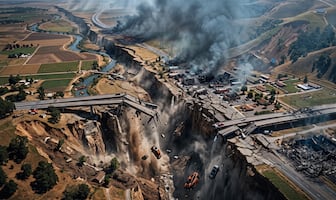


Rescue teams are searching this Thursday for more than 1,400 people missing on the border between Nepal and the Chinese autonomous region of Tibet, following sudden floods and landslides that left at least 362 dead and entire villages wiped out.
More than 24 hours after the catastrophe, an expert warned of the risk of new floods after a surge of water with a sweeping force similar to a tsunami razed entire villages, swallowed homes, and knocked down bridges and dams.
A terrifying surveillance video taken from the Chinese side shows how, on Wednesday morning, a torrent of mud and debris engulfs a multi-story building while dozens of people run for their lives.
Authorities in Nepal recovered the bodies of 359 people, and 24 hours after the disaster, they remain without news of 910 missing individuals, including 517 foreign tourists. On the Chinese side, in Tibet, the provisional toll reported by state media is three dead, but there are 558 people missing, including 260 foreigners.
The destructive torrent of water and mud, similar to a tsunami, was caused by the partial collapse of a glacier, with such violence that it was registered as a magnitude 5.2 "seismic event," according to the United States Geological Survey (USGS).


- "A gigantic graveyard" -
The flash flood swept through Nepal's Trishuli River valley, in the Nuwakot district, north of Kathmandu, and the Bhote Koshi valley, east of the capital.
"Everything is over," 35-year-old Omkar Joshi, who took refuge in the hills of the Nepali town of Timure, told AFP. "It is now nothing more than a gigantic graveyard. All that remains is sand and stones soaked in human blood."
The flood hit Syabrubesi, the starting point of the popular Langtang hiking route, as well as other areas used by travelers for the Hindu pilgrimage to Kailash Mansarovar.
In Syabrubesi, 27-year-old Laloma told AFP that he spent the whole night in a school with about a hundred people.
"Everything else (in the town) disappeared," he stated.
Among the missing foreigners are dozens of Hindu pilgrims who were heading to Mount Kailash, the sacred snow-covered mountain in Tibet.
According to the preliminary count by the Nepal Tourism Board, authorities still have no news of 178 citizens from India, 65 from the United States, 53 from Ukraine, 51 from Malaysia, 35 from Australia, 33 from the United Kingdom, and 25 from Canada. Spain said that four of its citizens are unaccounted for.

Madre e hija sobreviven a accidente, pero ICE las detiene en el hospital: “¿Por qué las tratan así?”

The Chinese Foreign Ministry indicated for its part that there were around one hundred Chinese citizens missing on the Nepali side.
Both Chinese Premier Li Qiang and his Nepali counterpart, Balendra Shah, traveled to the affected areas to oversee search and rescue efforts, according to Chinese state media and the office of the Nepali leader, respectively.
- Risk of new floods -
The Chinese government mobilized nearly 800 rescuers in the Tibet Autonomous Region, in addition to search dogs and speedboats to expedite rescue operations, the official Xinhua news agency reported.
However, the work is difficult in a mountainous area, and Li Qipu, a member of the People's Armed Police, a Chinese paramilitary force, noted that "the instability of a dam lake upstream" and "the narrow mountain road" are complicating rescue efforts.
In Nepal, rescuers are trying to clear a path through the mud and debris in search of survivors.
Among those looking for their relatives was Subash Khatani, who told AFP that he was trying to find his brother.

"He is among those missing in (the district of) Rasuwa, that's why we came out to look for him," he declared.
The director in Nepal for the International Federation of Red Cross and Red Crescent Societies (IFRC), David Fisher, warned about the scale of the catastrophe, after which "entire villages and commercial areas were wiped out."
Monsoon rains, from June to September, often cause deadly floods and landslides throughout South Asia. Scientists say that climate change is increasing the frequency and intensity of these types of extreme weather phenomena.
Additionally, global warming causes glaciers to melt worldwide, which increases the risk of flooding.
Qianggong Zhang, head of climate and environmental risks at the International Centre for Integrated Mountain Development (ICIMOD), based in Kathmandu, pointed out to AFP that there is a risk of a second surge due to "a blockage in the upper part of the border river between Nepal and China."


[Publicidad]